
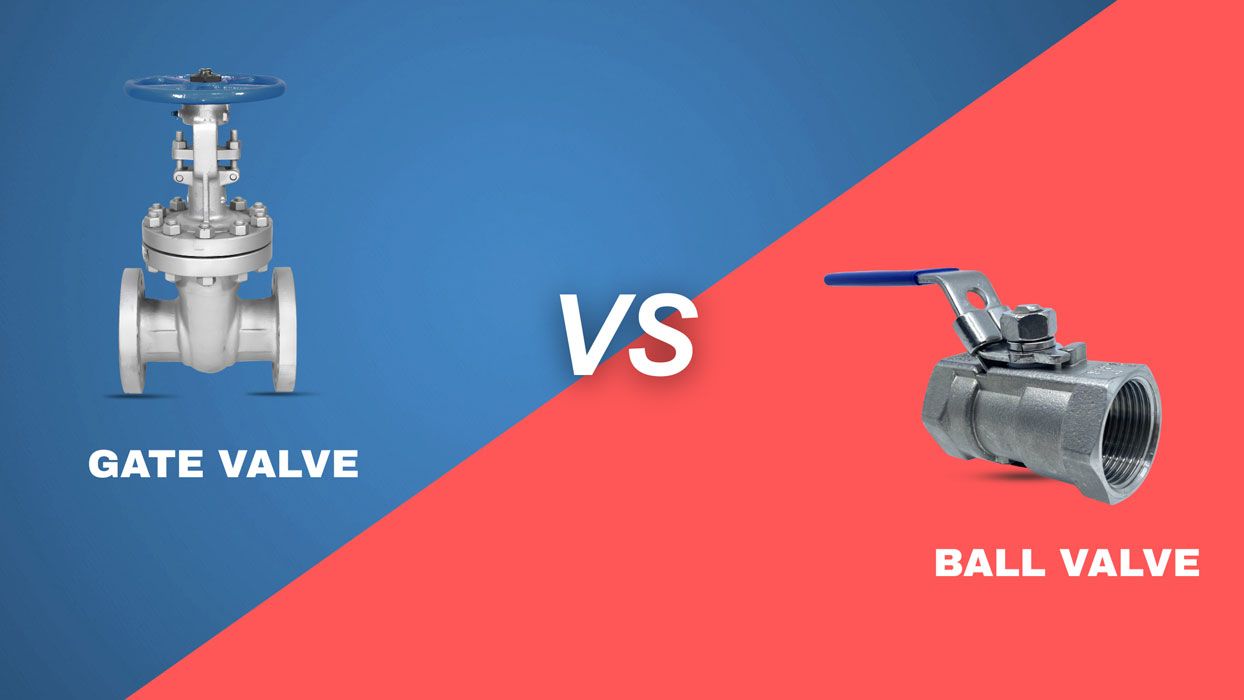
In industrial piping systems, selecting the right valve is critical for efficiency, safety, and long-term performance. Among the most widely used isolation valves are gate valves and ball valves. While both serve the same purpose,controlling or stopping fluid flow their design, operation, and applications differ significantly.
Understanding these differences helps engineers and procurement teams choose the best valve for their specific needs.
Understanding the Basics
Gate Valve
A gate valve operates using a sliding gate or wedge that moves vertically to start or stop flow. It requires multiple turns to fully open or close and is designed primarily for on/off isolation rather than flow regulation.
Ball Valve
A ball valve uses a rotating spherical ball with a hole through its center. A simple 90-degree turn allows or blocks flow instantly, making it a quarter-turn valve known for quick operation.
Key Differences Between Gate Valve and Ball Valve
1. Operating Mechanism
- Gate valve: Multi-turn, linear motion
- Ball valve: Quarter-turn, rotary motion
This fundamental difference affects speed, ease of use, and automation capability.
2. Sealing Performance
Ball valves provide a tighter seal due to full contact between the ball and seats, making them ideal for applications where leakage is unacceptable.
Gate valves can seal effectively, but wear and debris may reduce sealing efficiency over time.
Best choice for sealing: Ball valve
3. Speed of Operation
Ball valves can open or close almost instantly with a quarter turn.
Gate valves require multiple rotations, making them slower but more controlled.
Best choice for speed: Ball valve
4. Flow Characteristics & Pressure Drop
Gate valves offer unobstructed flow when fully open, resulting in minimal pressure loss.
Ball valves also perform well, especially full-bore designs, though reduced-bore types may create slight restriction.
Best choice for flow efficiency: Gate valve
5. Maintenance & Durability
Ball valves generally require less maintenance due to fewer moving parts.
Gate valves may need more frequent servicing, especially in applications involving frequent operation.
Best choice for low maintenance: Ball valve
6. Cost Consideration
- Gate valves: Lower upfront cost
- Ball valves: Higher initial cost but better long-term value
Lifecycle cost often favors ball valves due to reduced maintenance and longer service life.
When to Use Each Valve
Choose a Gate Valve When:
- You need full, unrestricted flow
- The valve will remain mostly open or closed
- Handling high-pressure or high-temperature systems
- Working with large pipelines or slurries
Choose a Ball Valve When:
- Fast shutoff is required (e.g., emergency systems)
- Frequent operation is expected
- Tight sealing is critical (gas, chemicals)
- Automation or compact design is needed
Quick Comparison Table:
| Feature | Gate Valve | Ball Valve |
| Operation | Multi-turn | Quarter-turn |
| Speed | Slow | Fast |
| Sealing | Moderate | Excellent |
| Pressure Drop | Very low | Low |
| Maintenance | Higher | Lower |
| Cost | Lower upfront | Better lifecycle |
Final Thoughts
Both gate valves and ball valves play essential roles in industrial systems, but the right choice depends on your application.
- For efficiency and tight shutoff, ball valves are often preferred
- For large pipelines and minimal flow restriction, gate valves remain a strong option
For industries such as oil & gas, water treatment, and process manufacturing, selecting the right valve ensures reliability, safety, and cost efficiency over time.
Why Choose Arrotop?
At Arrotop, we deliver precision-engineered flow control solutions tailored for demanding industrial environments. Whether you require robust gate valves for high-pressure systems or high-performance ball valves for reliable sealing, our products are designed to meet global standards and ensure long-term performance.
Explore our range of industrial valves to find the perfect solution for your application.