
Industrial process plants depend on precision, safety, and reliability. Whether it’s an oil refinery, chemical plant, power station, pharmaceutical facility, or instrumentation panel, every connection in the system must remain leak-free and perform consistently under pressure.
This is where Instrumentation Tube Fittings play a critical role.
Although small in size, these precision-engineered components are responsible for creating secure connections between tubing, valves, pressure gauges, transmitters, flow meters, analyzers, and other instrumentation devices. A poorly designed fitting can result in fluid leakage, inaccurate readings, equipment failure, costly downtime, and even safety hazards.
At Arrotop, we manufacture precision instrumentation tube fittings that are engineered to provide reliable, leak-tight performance in demanding industrial applications. Designed according to international quality standards, our fittings deliver excellent sealing capability, vibration resistance, corrosion resistance, and long service life.
What Are Instrumentation Tube Fittings?
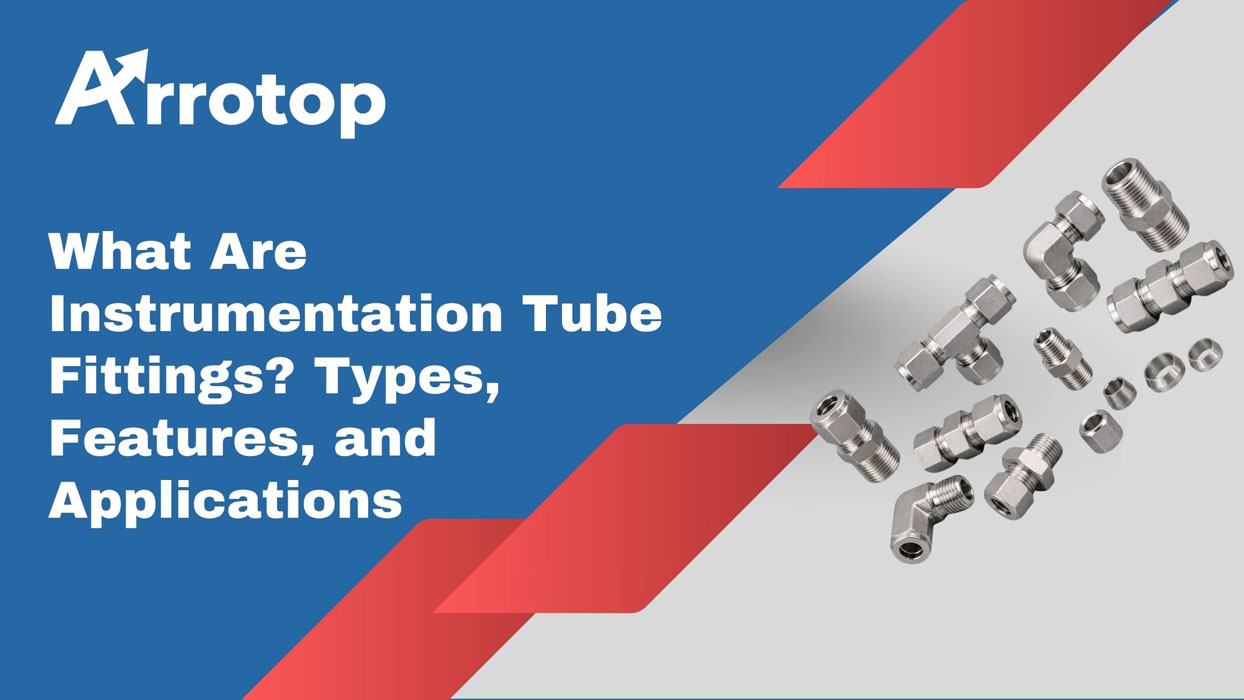
Instrumentation tube fittings are precision mechanical connectors used to join tubes with valves, gauges, pressure transmitters, manifolds, analyzers, flow meters, and other process equipment without leakage.
Unlike ordinary plumbing fittings, instrumentation fittings are manufactured with extremely tight tolerances because they operate in applications where:
- Pressure can exceed several thousand PSI
- Vibrations are continuous
- Temperature fluctuations are common
- Hazardous chemicals are transported
- Measurement accuracy is critical
Most industrial instrumentation tube fittings use a double ferrule compression design that provides excellent sealing without welding.
These fittings are extensively used in:
- Oil & Gas
- Petrochemical
- Chemical Processing
- Power Plants
- Pharmaceuticals
- Food Processing
- Water Treatment
- Marine
- Offshore Platforms
- Hydrogen & Renewable Energy Plants
Properly installed instrumentation fittings maintain system integrity while allowing easy maintenance and replacement whenever required.
Why Are Instrumentation Tube Fittings Important?
Instrumentation systems operate with highly sensitive measuring instruments.
Even a microscopic leak can cause:
- Pressure loss
- Incorrect flow readings
- Instrument malfunction
- Process interruption
- Product contamination
- Safety risks
- Increased maintenance costs
High-quality instrumentation fittings ensure:
- Leak-proof connections
- Stable process control
- Reliable instrumentation signals
- Reduced maintenance
- Longer equipment life
- Improved operational safety
How Instrumentation Tube Fittings Work
The most common instrumentation fitting is the double ferrule compression fitting.
When the nut is tightened:
- The front ferrule creates the primary pressure seal.
- The back ferrule grips the tubing securely.
- The tubing becomes mechanically locked.
- Metal-to-metal sealing prevents leakage.
- The connection withstands vibration and pressure fluctuations.
Unlike welded joints, compression fittings are reusable and require no hot work, making installation faster and safer.
Main Components of Instrumentation Tube Fittings
A standard compression tube fitting consists of:
Tube
The precision tubing that carries the process fluid or gas.
Nut
Applies compression force during tightening.
Front Ferrule
Creates the pressure-tight seal.
Back Ferrule
Grips the tubing and prevents pull-out.
Body
Provides the seating surface and houses the sealing mechanism.
Each component must be manufactured with high precision to ensure consistent sealing performance.
Types of Instrumentation Tube Fittings
Instrumentation systems require various fitting configurations depending on piping layout and application.
1. Union
Connects two tubes of identical size.
Applications:
- Instrument tubing
- Control panels
- Analyzer systems
2. Male Connector
Connects tubing to female threaded ports.
Common thread types include:
- NPT
- BSPT
- BSPP
- ISO
- SAE
3. Female Connector
Used to connect tubing with male threaded equipment.
Widely used with:
- Pressure gauges
- Transmitters
- Valves
4. Elbow Fittings
Used to change tubing direction.
Available in:
- 90° Elbow
- 45° Elbow
- Male Elbow
- Female Elbow
- Street Elbow
5. Tee Fittings
Split or combine fluid flow.
Types include:
- Male Tee
- Female Tee
- Branch Tee
- Street Tee
6. Cross Fittings
Provide four-way tubing connections.
Used in:
- Instrument manifolds
- Sampling systems
7. Reducers
Connect tubing of different diameters.
Ideal for:
- Flow reduction
- Instrument adaptation
8. Adapters
Convert one thread type into another.
Examples include:
- Male to Female
- NPT to BSP
- Tube to Pipe
- Weld to Thread
9. Caps & Plugs
Seal unused ports.
Prevent:
- Leakage
- Contamination
- Pressure loss
10. Bulkhead Fittings
Allow tubing to pass securely through panels and enclosures while maintaining pressure integrity.
11. Hex Nipples & Couplings
Used to join threaded components while providing easy wrench engagement.
12. Weld Fittings
Include:
- Weld Elbow
- Weld Tee
- Weld Adapter
Used where permanent joints are required.
Materials Used in Instrumentation Tube Fittings
Material selection depends on pressure, temperature, corrosion resistance, and the process fluid.
Arrotop manufactures instrumentation tube fittings in:
Stainless Steel
Suitable for general industrial applications requiring corrosion resistance and strength.
Duplex
Offers higher mechanical strength and improved chloride resistance.
Super Duplex
Ideal for offshore, seawater, and highly corrosive environments.
Inconel
Excellent for high-temperature oxidation and pressure applications.
Hastelloy
Preferred for highly corrosive acids and aggressive chemical media.
Monel
Excellent resistance to seawater, hydrofluoric acid, and marine environments.
Nickel
Suitable for caustic chemicals and reducing environments.
Titanium
Lightweight with exceptional corrosion resistance for marine and chemical processing.
Technical Specifications
Typical specifications include:
| Parameter | Specification |
| Pressure Rating | Up to 10,000 PSI (higher ratings available for specialized applications) |
| Temperature Range | -40°C to 400°C (material dependent) |
| Tube Sizes | 1/16″ to 2″ |
| Thread Types | NPT, BSPT, BSPP, ISO, SAE |
| Connection Type | Compression, Threaded, Socket Weld |
| Standards | ASTM, ASME, ANSI, ISO |
Specifications vary depending on material, fitting type, and application.
Advantages of Instrumentation Tube Fittings
Instrumentation tube fittings are critical components in industrial fluid and gas systems, providing secure, leak-free connections between tubing, valves, gauges, transmitters, analyzers, and other process instruments. Designed for high-pressure and demanding operating conditions, these fittings offer numerous advantages that improve system reliability, operational efficiency, and safety. Below are the key benefits in detail.
1. Leak-Free and Reliable Sealing
One of the most significant advantages of instrumentation tube fittings is their ability to provide a leak-tight connection. Precision-engineered double ferrule compression fittings create a strong metal-to-metal seal that prevents the escape of liquids or gases even under high operating pressures.
A reliable seal helps maintain process integrity, reduces product loss, minimizes environmental impact, and ensures accurate instrument readings. Leak-free performance is particularly important in industries handling hazardous chemicals, flammable gases, or high-purity fluids where even minor leakage can lead to safety risks and operational losses.
2. Excellent Performance in High-Pressure Applications
Instrumentation tube fittings are specifically designed to withstand demanding pressure conditions. Depending on the material and fitting design, they can operate safely at pressures reaching up to 10,000 PSI or higher in specialized applications.
Their robust construction ensures that the tubing remains securely locked in place while maintaining a pressure-tight seal, making them suitable for critical hydraulic, pneumatic, gas distribution, and process instrumentation systems.
3. Superior Corrosion Resistance
Industrial environments often expose components to moisture, chemicals, acids, alkalis, saltwater, and corrosive gases. Instrumentation tube fittings are available in corrosion-resistant materials such as Stainless Steel, Duplex, Super Duplex, Hastelloy, Monel, Inconel, Nickel, and Titanium, allowing them to perform reliably in aggressive environments.
This resistance to corrosion extends the service life of the fittings, reduces maintenance costs, and ensures long-term operational reliability even in offshore, marine, petrochemical, and chemical processing industries.
4. Outstanding Resistance to Vibration and Mechanical Shock
Many industrial plants experience continuous vibration from rotating machinery, compressors, pumps, turbines, and heavy equipment. Poor-quality fittings may loosen over time, leading to leakage or system failure.
Instrumentation tube fittings feature advanced ferrule designs that firmly grip the tubing while maintaining sealing integrity during continuous vibration, pressure pulsations, and mechanical shocks. This makes them highly suitable for mobile equipment, offshore platforms, and heavy industrial installations.
5. Easy Installation Without Welding
Unlike welded pipe connections, instrumentation tube fittings can be installed quickly without requiring welding, brazing, soldering, or special fabrication equipment. Installation involves inserting the tube into the fitting and tightening the nut according to the manufacturer’s instructions.
The elimination of hot work not only reduces installation time but also minimizes fire hazards, simplifies field assembly, and lowers labor costs.
6. Reusable and Easy to Maintain
Instrumentation tube fittings can often be disconnected and reassembled without damaging the fitting body, provided proper installation procedures are followed. This reusability makes system maintenance, equipment replacement, and process modifications easier and more cost-effective.
Maintenance personnel can inspect, clean, replace, or modify instrumentation systems without replacing the entire fitting assembly.
7. High Dimensional Accuracy
Precision machining ensures that every component of the fitting is manufactured within tight tolerances. Accurate dimensions allow for proper ferrule engagement, consistent sealing performance, and interchangeability between fittings of the same specification.
Dimensional consistency also simplifies installation and reduces the likelihood of connection failures caused by manufacturing variations.
8. Wide Temperature Compatibility
Instrumentation tube fittings are designed to operate across a broad temperature range depending on the material selected. Whether used in cryogenic applications, high-temperature steam systems, or chemical processing plants, the fittings maintain their mechanical strength and sealing capability under varying thermal conditions.
This versatility makes them suitable for applications ranging from extremely low temperatures to elevated process temperatures.
9. Excellent Mechanical Strength
High-quality instrumentation fittings possess superior tensile strength, fatigue resistance, and structural stability. They are capable of withstanding continuous operating stresses, cyclic loading, pressure fluctuations, and thermal expansion without compromising sealing performance.
Their durable construction contributes to longer service life and reduced equipment failure.
10. Enhanced Process Safety
Leak-proof connections reduce the possibility of hazardous fluid or gas escaping into the working environment. This improves personnel safety, protects nearby equipment, and helps facilities comply with environmental and industrial safety regulations.
Reliable instrumentation fittings also contribute to stable process control by maintaining consistent pressure and flow characteristics.
11. Wide Material Availability
Instrumentation tube fittings are manufactured in a variety of high-performance alloys to suit different operating conditions.
Common materials include:
- Stainless Steel
- Duplex
- Super Duplex
- Hastelloy
- Inconel
- Monel
- Nickel
- Titanium
The availability of multiple material options allows engineers to select fittings based on corrosion resistance, temperature limits, pressure ratings, and chemical compatibility.
12. Compatibility with Various Thread Standards
Instrumentation fittings are available with multiple international thread standards, making them compatible with equipment manufactured worldwide.
Common thread types include:
- NPT
- BSPT
- BSPP
- ISO Threads
- SAE Threads
This flexibility simplifies integration into existing industrial systems and reduces the need for additional adapters.
13. Reduced Maintenance Costs
Because of their reliable sealing performance and durable construction, instrumentation tube fittings require minimal maintenance over their service life. Reduced leakage, fewer replacements, and less downtime translate into lower overall operating costs.
Facilities benefit from improved productivity while minimizing maintenance-related expenses.
14. Long Service Life
Premium materials combined with precision manufacturing provide exceptional durability. Instrumentation tube fittings resist wear, corrosion, vibration, and pressure fatigue, allowing them to remain in service for many years with minimal performance degradation.
Their long operational life contributes to lower lifecycle costs and improved equipment reliability.
15. Suitable for Critical Instrumentation Systems
Instrumentation tube fittings are widely used in applications where measurement accuracy and process reliability are essential. They maintain stable pressure and prevent leakage, ensuring that sensors, transmitters, analyzers, and flow measurement devices deliver accurate data.
Reliable instrumentation directly contributes to better process control, product quality, and plant efficiency.
Features of Instrumentation Tube Fittings
Instrumentation tube fittings are precision-engineered components manufactured to deliver reliable performance under demanding industrial conditions. Their advanced design, material quality, and manufacturing accuracy ensure dependable operation in fluid and gas handling systems.
Precision-Engineered Double Ferrule Design
The double ferrule compression mechanism provides exceptional gripping strength and sealing performance. The front ferrule forms the primary pressure seal while the back ferrule securely grips the tubing to prevent pull-out during high-pressure operation.
Leak-Proof Metal-to-Metal Sealing
Precision-machined sealing surfaces create a reliable metal-to-metal seal that eliminates leakage without requiring sealants or welding.
High Pressure Capability
Designed for demanding industrial services, instrumentation tube fittings safely operate in high-pressure hydraulic, pneumatic, gas, and process systems while maintaining sealing integrity.
Excellent Corrosion Resistance
Available in premium corrosion-resistant alloys, these fittings withstand aggressive chemicals, marine environments, offshore installations, and corrosive process fluids.
Vibration Resistant Construction
The advanced ferrule design maintains a secure tube grip even under continuous vibration, pulsating pressure, and mechanical shock, reducing the risk of loosening during operation.
High Dimensional Accuracy
Every component is precision-machined using advanced manufacturing processes to ensure perfect fit, consistent sealing performance, and easy interchangeability.
Wide Temperature Range
Instrumentation tube fittings maintain reliable sealing performance across a broad operating temperature range, making them suitable for cryogenic, ambient, and elevated-temperature applications.
Multiple Connection Configurations
Available in numerous configurations including:
- Union
- Elbow
- Tee
- Cross
- Reducer
- Adapter
- Bulkhead
- Male Connector
- Female Connector
- Plug
- Cap
- Weld Connector
- Coupling
- Hex Nipple
This wide product range allows engineers to design complex instrumentation systems efficiently.
Multiple Thread Standards
Compatible with various international thread specifications including NPT, BSPP, BSPT, ISO, and SAE, ensuring seamless integration with global equipment.
Easy Installation
Compression fittings require no welding, soldering, or brazing, significantly reducing installation time while simplifying maintenance and future modifications.
Reusable Design
When installed correctly, fittings can often be disconnected and reassembled during maintenance, minimizing replacement costs and improving operational flexibility.
Wide Material Selection
Manufactured in various corrosion-resistant alloys to suit different industrial environments and process requirements.
Long Operational Life
Precision engineering, premium materials, and durable construction provide years of reliable performance even in severe operating conditions.
Low Maintenance Requirements
Leak-free sealing and high mechanical strength reduce maintenance frequency, lowering overall lifecycle costs.
Compliance with International Standards
Manufactured according to internationally accepted engineering standards to ensure consistent quality, safety, and performance.
Applications of Instrumentation Tube Fittings
Instrumentation tube fittings are used wherever reliable fluid or gas connections are required for process control, measurement, and instrumentation systems. Their ability to withstand high pressure, corrosion, vibration, and temperature variations makes them indispensable across numerous industries.
Oil & Gas Industry
Instrumentation tube fittings are extensively used in upstream, midstream, and downstream operations, including offshore platforms, drilling rigs, refineries, pipelines, compressor stations, LNG terminals, and gas processing facilities. They connect pressure transmitters, gauges, control valves, analyzers, and sampling systems while ensuring leak-free operation in hazardous environments.
Petrochemical Industry
Petrochemical plants require instrumentation systems capable of handling aggressive chemicals, high temperatures, and elevated pressures. Tube fittings are used in reactors, distillation columns, storage terminals, and process control systems to maintain safe and efficient operations.
Chemical Processing Plants
Chemical manufacturing facilities use instrumentation tube fittings for acid transfer systems, chemical dosing units, reactors, solvent handling, and analytical equipment. Corrosion-resistant materials ensure long-term reliability when exposed to highly aggressive chemicals.
Power Generation
Thermal, nuclear, hydroelectric, and renewable energy plants rely on instrumentation fittings in steam systems, turbine controls, fuel gas lines, boiler instrumentation, cooling water systems, and process monitoring equipment.
Pharmaceutical Industry
Pharmaceutical manufacturing requires precise process control and contamination-free fluid handling. Instrumentation tube fittings are used in clean utilities, sterile processing systems, laboratory equipment, and analytical instrumentation to maintain product quality and regulatory compliance.
Food & Beverage Industry
Instrumentation fittings are used in food processing plants, beverage production facilities, dairies, breweries, and packaging lines where reliable process monitoring and hygienic fluid handling are essential.
Water & Wastewater Treatment
Water treatment facilities utilize instrumentation tube fittings in filtration systems, chemical dosing equipment, reverse osmosis plants, desalination units, chlorination systems, and process monitoring instruments to ensure efficient water management.
Marine & Offshore Industry
Marine vessels, offshore platforms, FPSOs, and shipbuilding applications require corrosion-resistant instrumentation fittings for hydraulic systems, fuel systems, ballast control, cooling circuits, and instrumentation panels operating in harsh seawater environments.
Hydrogen and Renewable Energy
As hydrogen infrastructure expands, instrumentation tube fittings are increasingly used in electrolyzers, hydrogen storage systems, fueling stations, fuel cell technologies, and renewable energy projects requiring leak-free gas handling.
Semiconductor & Electronics Manufacturing
Ultra-high purity gas distribution systems, cleanroom process equipment, and precision analytical instruments depend on high-quality instrumentation tube fittings to maintain contamination-free operations.
Pulp & Paper Industry
Instrumentation fittings are used throughout pulp digesters, bleaching plants, chemical recovery systems, steam distribution networks, and process control equipment.
Mining & Mineral Processing
Mining operations utilize instrumentation fittings in slurry handling systems, flotation plants, mineral processing equipment, chemical injection systems, and process monitoring applications operating under severe conditions.
Fertilizer Industry
Fertilizer plants employ instrumentation tube fittings in ammonia handling systems, urea plants, process reactors, storage facilities, and control instrumentation to ensure safe operation.
Aerospace & Defense
Aircraft hydraulic systems, ground support equipment, aerospace testing facilities, and defense manufacturing utilize precision instrumentation tube fittings where reliability and safety are critical.
Research Laboratories & Analytical Systems
Scientific laboratories, calibration facilities, and testing laboratories use instrumentation fittings in gas chromatography, analytical equipment, calibration benches, and research instruments requiring accurate and leak-free fluid connections.
Process Automation and Control Panels
Instrumentation tube fittings form the backbone of automated industrial control systems by connecting pressure transmitters, flow meters, analyzers, manifolds, valves, and control instruments, ensuring accurate process monitoring and efficient plant automation.
Installation Best Practices
For optimum performance:
- Use seamless precision tubing.
- Cut tubing squarely.
- Remove burrs before installation.
- Insert tubing fully into the fitting body.
- Follow the recommended tightening procedure.
- Avoid over-tightening.
- Do not mix ferrules from different manufacturers.
- Inspect fittings periodically for wear or damage.
Proper installation is essential to achieve the designed leak-tight seal.
Common Problems and Their Causes
| Problem | Possible Cause |
| Leakage | Improper installation or insufficient tightening |
| Tube pull-out | Incorrect ferrule engagement |
| Thread damage | Cross-threading or over-tightening |
| Corrosion | Incorrect material selection |
| Vibration failure | Inadequate support or unsuitable fitting design |
| Pressure loss | Damaged ferrules or worn sealing surfaces |
How to Choose the Right Instrumentation Tube Fitting
Before selecting a fitting, consider:
- Operating pressure
- Working temperature
- Tube outside diameter
- Thread type
- Fluid or gas compatibility
- Corrosion resistance
- Installation environment
- Applicable industry standards
- Maintenance requirements
Selecting the appropriate material and fitting design helps maximize reliability, safety, and service life.
Why Choose Arrotop Instrumentation Tube Fittings?
Arrotop manufactures high-quality instrumentation tube fittings engineered for precision, durability, and leak-free performance in critical industrial systems.
Our product range includes:
- Compression Tube Fittings
- Male & Female Connectors
- Elbows
- Tees
- Crosses
- Adapters
- Reducers
- Caps
- Plugs
- Bulkhead Fittings
- Weld Fittings
- Hex Nipples
- Couplings
Available in a wide selection of corrosion-resistant alloys, Arrotop fittings are suitable for high-pressure, high-temperature, and demanding process environments. Every fitting is precision-machined to ensure dependable sealing, dimensional accuracy, and long-term reliability across industries such as oil & gas, chemical processing, power generation, pharmaceuticals, water treatment, and marine applications.