
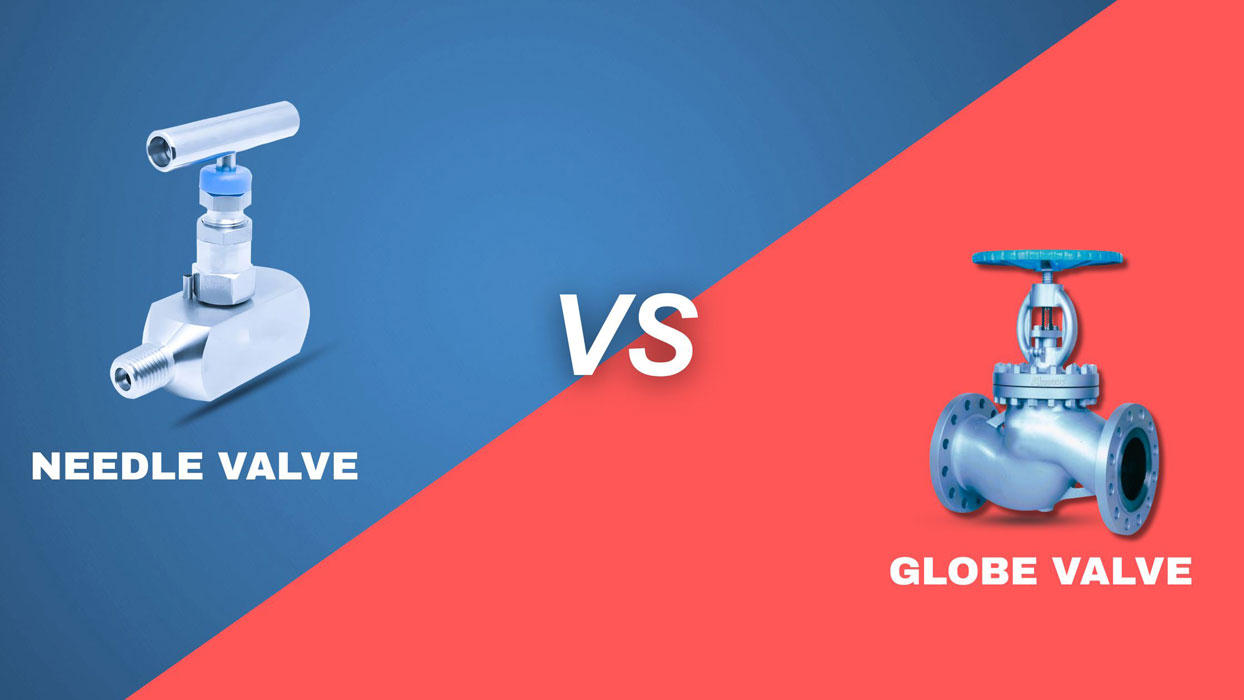
Selecting the right valve is one of the most important decisions in any industrial piping or instrumentation system. Whether you’re designing a high-pressure instrumentation panel, a chemical dosing system, a steam pipeline, or a process control loop, choosing the wrong valve can lead to inaccurate flow control, excessive pressure loss, premature wear, or even system failure.
Among the most commonly used flow control valves are Needle Valves and Globe Valves. Although both are designed to regulate fluid flow, they serve different purposes and perform best under different operating conditions.
A Needle Valve is specifically engineered for highly accurate flow regulation, making it the preferred choice for instrumentation and analytical systems. In contrast, a Globe Valve is designed to handle larger flow capacities while providing reliable throttling and shut-off capabilities in industrial process lines.
This comprehensive guide explains every important aspect of both valve types, including their construction, working principles, advantages, disadvantages, applications, and the key differences that help engineers select the right valve.
What is a Needle Valve?
A Needle Valve is a precision flow control valve that uses a long, tapered needle-shaped stem to regulate fluid passing through a very small seat opening.
Unlike conventional shut-off valves, the needle valve allows operators to make extremely fine adjustments to flow rate. Even a slight turn of the handwheel produces a very small movement of the needle, enabling accurate flow control.
Because of this precision, needle valves are widely used in:
- Instrumentation systems
- Pressure gauges
- Hydraulic systems
- Pneumatic circuits
- Sampling panels
- Gas distribution systems
- Calibration equipment
- Laboratory applications
Needle valves are particularly suitable for applications where stable and repeatable flow adjustment is essential.
How Does a Needle Valve Work?
The operation of a needle valve is relatively simple.
When the handle rotates:
- The threaded stem moves vertically.
- The tapered needle gradually enters or exits the valve seat.
- This changes the flow area.
- Flow increases or decreases with exceptional precision.
Because the opening changes very gradually, operators can precisely regulate even extremely low flow rates.
This makes needle valves ideal for applications where flow stability directly affects measurement accuracy or process performance.
Main Components of a Needle Valve
A typical needle valve consists of:
- Valve Body
- Needle Stem
- Valve Seat
- Bonnet
- Packing
- Packing Nut
- Handle or Handwheel
- Threaded Stem
- End Connections (NPT, BSP, Compression Tube Ends, Socket Weld, etc.)
Advantages of Needle Valves
1. Extremely Precise Flow Control
Needle valves provide exceptional control over fluid flow, allowing operators to make minute adjustments with high repeatability. This level of precision is essential in systems where even a slight variation in flow can affect measurement accuracy, equipment performance, or process stability.
2. Excellent Leak Tightness
The tapered needle design creates a highly effective sealing surface, helping minimize leakage during shut-off. This makes needle valves suitable for applications involving gases, hazardous fluids, and high-purity media where tight isolation is critical.
3. Suitable for High Pressure Applications
Many needle valves are engineered to withstand very high operating pressures while maintaining reliable performance. Their robust construction allows them to be used safely in demanding hydraulic, instrumentation, and pressure control systems.
4. Smooth Flow Regulation
The threaded stem mechanism allows gradual movement of the needle, resulting in smooth and stable flow adjustments. This helps eliminate sudden pressure fluctuations and provides better control during operation.
5. Compact Design
Needle valves are generally compact and lightweight, making them ideal for installations where space is limited, such as instrumentation panels, analyzers, and control cabinets.
6. Long Service Life
High-quality needle valves are designed for repeated throttling without significant wear. Durable materials and precision-machined components contribute to long operational life with minimal maintenance.
7. Excellent for Instrumentation Systems
Needle valves are specifically suited for pressure gauges, transmitters, calibration systems, sampling panels, and analytical equipment where accurate flow regulation and dependable isolation are required.
Applications of Needle Valves
Needle valves are extensively used across industries where precise control and reliable isolation are essential.
Oil & Gas
- Instrument impulse lines
- Pressure measurement systems
- Wellhead control panels
- Hydraulic power units
- Gas sampling systems
Petrochemical Plants
- Chemical dosing
- Reactor instrumentation
- Process analyzers
- High-pressure chemical lines
- Utility services
Power Generation
- Boiler instrumentation
- Steam sampling systems
- Turbine control circuits
- Condensate monitoring
- Pressure gauge isolation
Pharmaceutical Industry
- Clean process instrumentation
- Sampling systems
- High-purity fluid control
- Laboratory equipment
Food & Beverage
- Hygienic instrumentation
- Process sampling
- Flow measurement systems
Hydraulic Systems
- Flow balancing
- Pressure regulation
- Test benches
- Hydraulic manifolds
Laboratories
- Gas control
- Analytical equipment
- Calibration instruments
- Research facilities
What is a Globe Valve?
A Globe Valve is a linear motion valve designed for throttling, regulating, and shutting off fluid flow in industrial pipelines.
The valve gets its name from its historically spherical body shape. Modern globe valves may have different body designs, but the operating principle remains the same.
Unlike a needle valve, a globe valve uses a movable disc that presses against a stationary seat to regulate flow. This design allows it to handle larger flow rates while providing good throttling characteristics.
Globe valves are commonly used in:
- Steam systems
- Water distribution
- Chemical processing
- Power plants
- HVAC systems
- Oil & gas pipelines
- Marine systems
- Industrial utilities
How Does a Globe Valve Work?
A globe valve operates through linear movement of a disc connected to a stem.
When the handwheel is turned:
- The stem moves upward or downward.
- The disc lifts away from or moves toward the seat.
- The flow area changes accordingly.
- Flow increases or decreases based on the position of the disc.
The internal flow path changes direction inside the valve body, which improves throttling performance but results in a higher pressure drop compared to straight-through valves.
Main Components of a Globe Valve
- Valve Body
- Bonnet
- Disc
- Valve Seat
- Stem
- Packing
- Gland
- Handwheel
- Yoke
- End Connections
Advantages of Globe Valves
1. Excellent Throttling Capability
Globe valves are specifically designed for regulating flow over a wide operating range. Their disc and seat arrangement provides stable throttling performance, making them suitable for applications where continuous flow adjustment is required.
2. Reliable Shut-Off Performance
When fully closed, the disc presses firmly against the seat, providing dependable isolation and minimizing leakage. This makes globe valves suitable for systems that require frequent opening and closing.
3. Suitable for Large Flow Rates
Compared with needle valves, globe valves can handle significantly higher flow capacities, making them ideal for medium and large industrial pipelines carrying liquids, gases, or steam.
4. Durable Construction
Globe valves are built to withstand demanding operating conditions, including high temperatures, elevated pressures, and frequent cycling. Their rugged construction contributes to long-term reliability in industrial environments.
5. Easy Maintenance
Many globe valve designs allow internal components such as the disc, seat, and stem to be inspected or replaced without removing the entire valve from the pipeline, reducing maintenance time and costs.
6. Wide Material Availability
Globe valves are manufactured in a variety of materials to suit different process conditions, including corrosion-resistant alloys, carbon steel, stainless steel, duplex alloys, and specialty materials for aggressive media.
7. Versatile Industrial Use
Their ability to regulate flow and provide positive shut-off makes globe valves suitable for a broad range of industries, from utilities and HVAC systems to power generation, chemical processing, and oil & gas operations.
Applications of Globe Valves
Power Plants
- Steam control
- Boiler feedwater systems
- Cooling water circuits
- Turbine bypass lines
- Condensate systems
Chemical Processing
- Acid transfer
- Process control
- Utility services
- Chemical reactors
Oil & Gas
- Pipeline isolation
- Process flow regulation
- Fuel systems
- Refinery utilities
Marine Industry
- Cooling systems
- Ballast systems
- Fuel transfer
- Engine room piping
HVAC Systems
- Chilled water
- Hot water
- Temperature control
- Building utilities
Water Treatment
- Filtration systems
- Distribution networks
- Chemical dosing
- Pump stations
Needle Valve vs. Globe Valve: Major Differences
| Feature | Needle Valve | Globe Valve |
| Flow Control | Extremely precise | Good, but less precise |
| Primary Purpose | Fine flow regulation | Flow regulation and shut-off |
| Flow Capacity | Low | Medium to High |
| Pressure Rating | Very High | High |
| Flow Accuracy | Excellent | Moderate |
| Pressure Drop | Moderate | Higher |
| Valve Size | Compact | Larger |
| Operating Speed | Slow, precise adjustments | Faster operation |
| Best For | Instrumentation systems | Process pipelines |
| Typical Media | Gas, liquids, hydraulic fluids | Steam, water, oil, chemicals |
| Maintenance | Low | Moderate |
| Cost | Generally lower for small sizes | Higher for larger industrial sizes |
When Should You Choose a Needle Valve?
A needle valve is the preferred option when your application demands:
- Extremely precise flow adjustment
- High-pressure instrumentation
- Pressure gauge isolation
- Gas sampling
- Analytical equipment
- Hydraulic control systems
- Low flow rates
- Calibration systems
- Laboratory equipment
- Fine throttling
When Should You Choose a Globe Valve?
A globe valve is better suited for applications requiring:
- Higher flow capacities
- Industrial process pipelines
- Steam distribution
- Cooling water systems
- Chemical processing
- Utility services
- Process flow regulation
- Frequent operation
- General industrial throttling
Features of Needle Valve
Needle valves are specially engineered for applications where precise flow regulation and dependable shut-off are essential. Their unique design enables operators to accurately control very small flow rates while maintaining excellent sealing performance under high-pressure conditions. These valves are widely used in instrumentation, hydraulic systems, pneumatic circuits, chemical processing, and analytical equipment where precision is critical.
1. Precision Flow Control
The most distinguishing feature of a needle valve is its ability to provide exceptionally accurate flow regulation. The tapered needle-shaped stem moves gradually into the valve seat, allowing operators to make minute adjustments to the flow rate. This precision is essential for applications such as pressure gauges, calibration systems, gas sampling, and laboratory equipment where even slight variations in flow can affect system performance.
2. Tapered Needle and Seat Design
Unlike other valve types, the needle valve features a long, slender, conical needle that fits precisely into a matching seat. This design enables smooth throttling, minimizes turbulence, and provides excellent control over fluid movement. It also creates a highly reliable sealing surface when the valve is fully closed.
3. Fine Threaded Stem Mechanism
The threaded stem of a needle valve moves slowly with each rotation of the handwheel. This allows gradual opening and closing, preventing sudden pressure changes and enabling highly controlled flow adjustments. Operators can achieve repeatable settings with exceptional accuracy.
4. Bubble-Tight Shut-Off
Needle valves are designed to provide leak-tight sealing even under demanding operating conditions. The precision-machined needle and seat ensure minimal leakage, making these valves suitable for hazardous gases, high-purity fluids, and pressure-sensitive applications.
5. High Pressure Capability
Many industrial needle valves are manufactured to withstand extremely high pressures, making them suitable for hydraulic systems, gas distribution networks, instrumentation panels, and offshore applications. Their robust construction ensures reliable operation without compromising flow accuracy.
6. Compact and Space-Efficient Design
Needle valves have a compact body configuration that allows easy installation in confined spaces such as instrumentation manifolds, control cabinets, skids, and analytical panels. Their small footprint makes them ideal for systems where installation space is limited.
7. Excellent Corrosion Resistance
Needle valves are available in various corrosion-resistant materials including Stainless Steel 304, Stainless Steel 316, Duplex, Super Duplex, Monel, Hastelloy, Inconel, Titanium, and Brass. This enables them to handle aggressive chemicals, seawater, corrosive gases, acids, and high-temperature fluids.
8. Multiple End Connection Options
Industrial needle valves are available with numerous connection types, including NPT, BSPT, BSPP, Compression Tube Ends, Socket Weld, Butt Weld, and Flanged Ends, allowing compatibility with different piping systems and international standards.
9. Low Operating Torque
The ergonomic handle and precision-threaded stem reduce the effort required to operate the valve. Smooth operation minimizes operator fatigue and allows accurate adjustments even during frequent use.
10. Long Operational Life
Manufactured using precision machining and high-quality materials, needle valves offer exceptional durability. Their wear-resistant internal components ensure consistent performance over thousands of operating cycles with minimal maintenance.
11. Low Internal Leakage
The close tolerance between the needle and seat significantly reduces internal leakage, improving process reliability and preventing unnecessary product loss.
12. Suitable for Critical Instrumentation
Needle valves are specifically designed for applications involving pressure transmitters, flow meters, differential pressure systems, calibration benches, and process analyzers where precise fluid regulation is essential.
Advantages of Needle Valve
Exceptional Precision
Needle valves provide unmatched accuracy when regulating low flow rates. This precision improves process efficiency, measurement reliability, and overall system stability.
Excellent Flow Stability
The gradual movement of the tapered needle eliminates sudden flow fluctuations and pressure spikes, ensuring smooth operation throughout the system.
Reliable Leak Prevention
The precision-machined sealing surfaces provide superior shut-off performance, reducing leakage and enhancing operational safety.
High Pressure Performance
Needle valves maintain reliable operation even in extremely high-pressure systems, making them suitable for hydraulic, pneumatic, and instrumentation applications.
Improved Equipment Protection
Accurate flow regulation protects downstream instruments, pumps, sensors, and process equipment from pressure surges and hydraulic shock.
Reduced Maintenance Costs
Their simple construction, durable materials, and precision components require minimal maintenance, reducing downtime and lifecycle costs.
Compact Installation
The small valve body simplifies installation in crowded piping layouts and instrumentation panels while maintaining excellent accessibility.
Long Service Life
High-quality manufacturing, corrosion-resistant materials, and precision engineering ensure long operational life even under continuous industrial service.
Excellent Chemical Compatibility
Available in specialty alloys, needle valves can safely handle aggressive chemicals, corrosive gases, acids, solvents, hydrocarbons, and specialty process fluids.
Energy Efficient Operation
Accurate flow control reduces unnecessary fluid loss, minimizes pressure drops, and contributes to improved process efficiency and energy savings.
Versatile Industrial Usage
Needle valves are suitable for gases, liquids, steam, hydraulic oils, compressed air, cryogenic fluids, and specialty chemicals across a wide variety of industries.
Easy Integration
They integrate seamlessly with instrumentation panels, pressure transmitters, gauges, manifolds, and automated process control systems.
Applications of Needle Valve
Oil & Gas Industry
Needle valves play a vital role in upstream, midstream, and downstream oil and gas operations. They are used for pressure gauge isolation, wellhead control systems, gas sampling panels, chemical injection skids, hydraulic control circuits, offshore platforms, pipeline instrumentation, compressor stations, and custody transfer systems. Their ability to withstand high pressures while maintaining precise flow control makes them indispensable in this sector.
Petrochemical Industry
Petrochemical plants rely on needle valves for regulating process fluids, controlling chemical dosing, sampling hazardous media, instrumentation panels, reactor systems, and process analyzers. Their corrosion-resistant materials ensure safe operation in chemically aggressive environments.
Chemical Processing
Needle valves provide accurate metering of acids, alkalis, solvents, specialty chemicals, and process additives. They are commonly used in reactors, laboratory systems, pilot plants, mixing units, and dosing systems.
Power Generation
Power plants use needle valves in steam sampling systems, condensate monitoring, turbine instrumentation, boiler controls, cooling water systems, pressure measurement circuits, and hydraulic actuators to improve operational efficiency and safety.
Hydraulic Systems
Hydraulic machinery uses needle valves to regulate oil flow, control actuator speed, balance hydraulic circuits, protect equipment from pressure spikes, and improve system responsiveness.
Pneumatic Systems
Needle valves regulate compressed air flow in automation equipment, pneumatic cylinders, robotics, packaging machines, manufacturing plants, and process control systems.
Pharmaceutical Industry
Needle valves provide contamination-free flow regulation in sterile production lines, laboratory equipment, analytical instruments, clean-room facilities, and high-purity process systems.
Food & Beverage Industry
Used in ingredient dosing, carbonation systems, cleaning-in-place (CIP) equipment, beverage processing, hygienic production lines, and quality control instrumentation.
Water Treatment Plants
Applications include chemical injection systems, filtration equipment, sampling panels, pressure monitoring, flow measurement, and water quality analysis.
Marine & Offshore Industry
Needle valves are installed in ballast systems, hydraulic steering controls, fuel systems, engine room instrumentation, offshore production platforms, and seawater handling equipment.
Aerospace Industry
Used in aircraft testing systems, hydraulic control circuits, fuel delivery systems, research laboratories, and precision calibration equipment.
Semiconductor Manufacturing
Needle valves regulate ultra-high-purity gases, specialty chemicals, and process fluids in semiconductor fabrication facilities where contamination control is critical.
Research Laboratories
Laboratories utilize needle valves in analytical instruments, chromatography systems, gas distribution networks, vacuum systems, calibration benches, and scientific research equipment.
Material Options
Industrial needle and globe valves are available in a wide range of materials to suit different service conditions, including:
- Stainless Steel 304 / 304L
- Stainless Steel 316 / 316L
- Duplex Stainless Steel
- Super Duplex Stainless Steel
- Monel
- Inconel
- Hastelloy
- Titanium
- Brass
- Carbon Steel
- Alloy Steel
The choice of material depends on the operating pressure, temperature, corrosion resistance requirements, and the nature of the process fluid.
Factors to Consider When Selecting the Right Valve
Before selecting a valve, evaluate the following:
- Required flow control accuracy
- Operating pressure
- Operating temperature
- Flow rate
- Fluid type (liquid, gas, steam, slurry)
- Corrosion resistance requirements
- Pipe size
- Installation space
- Maintenance requirements
- Budget
- Industry standards and compliance
Matching these factors with the valve’s design characteristics ensures optimal performance, reliability, and long service life.
Conclusion
Both Needle Valves and Globe Valves are essential components in industrial fluid control systems, but they are designed for different purposes.
If your application requires exceptional precision, low flow control, and high-pressure instrumentation, a Needle Valve is the ideal choice. Its fine-threaded stem and tapered needle provide accurate, repeatable flow adjustments that are critical in instrumentation, hydraulic, pneumatic, and analytical systems.
On the other hand, if your system involves larger pipelines, higher flow rates, steam services, or general process control, a Globe Valve offers reliable throttling, dependable shut-off, and long-term durability. Its robust design makes it well suited for power generation, chemical processing, oil & gas, water treatment, and industrial utility applications.
Understanding the differences between these two valve types allows engineers and procurement professionals to select the most suitable solution based on operating conditions, process requirements, and long-term performance objectives.
At Arrotop, we manufacture precision-engineered Needle Valves, Globe Valves, Valve Manifolds, Instrumentation Tube Fittings, Orifice Plates, and other flow control solutions designed to meet the demanding requirements of industrial, process, and instrumentation applications.