
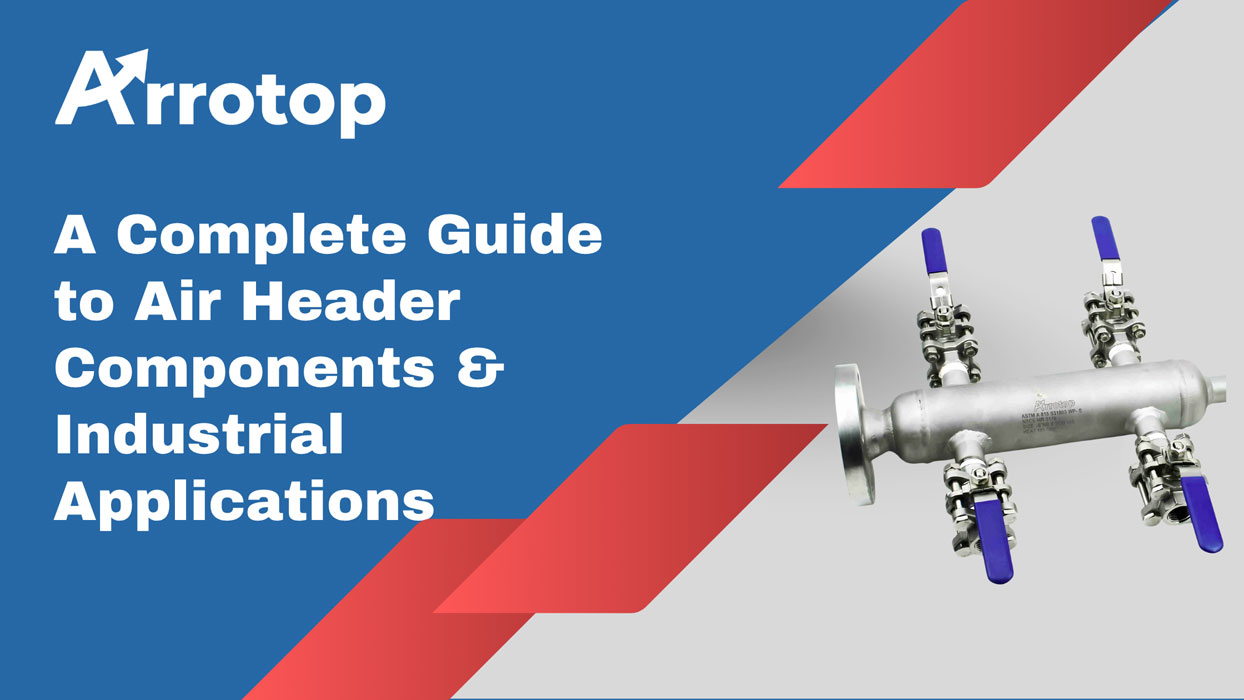
Compressed air systems are the backbone of modern industrial automation. From operating pneumatic instruments and actuators to distributing clean compressed air across process plants, industries rely heavily on efficient air distribution systems to maintain operational stability and safety. One of the most critical yet often overlooked components in these systems is the Air Header.
Air headers play a vital role in distributing compressed air from a single supply source to multiple outlets efficiently and safely. Widely used in industries such as oil & gas, chemical processing, power generation, pharmaceuticals, marine, and instrumentation systems, air headers simplify pneumatic connections while improving system organization and reliability.
As industries continue to move toward automation and precision instrumentation, the demand for high-quality air headers with corrosion-resistant materials, accurate specifications, and long-term durability has increased significantly.
At Arrotop, industrial air distribution solutions are designed to meet the performance, pressure, and reliability requirements of modern industrial environments.
What is an Air Header?
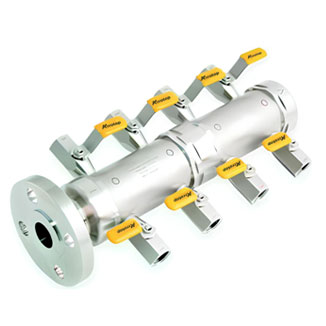
An air header is a distribution manifold designed to divide compressed air or gas from a single inlet into multiple outlet connections. It acts as a centralized pneumatic distribution unit that supplies air to several instruments, valves, actuators, or control systems simultaneously.
Instead of installing multiple independent air supply lines, industries use air headers to simplify piping layouts and improve operational efficiency.
Air headers are commonly installed in:
- Instrument air systems
- Pneumatic control panels
- Process plants
- Compressor distribution systems
- Automation systems
- Offshore platforms
They are also known as:
- Air distribution manifolds
- Pneumatic manifolds
- Instrument air headers
Why Are Air Headers Important in Industrial Systems?
Modern industrial facilities require reliable compressed air distribution to ensure uninterrupted process control. Air headers help centralize air supply systems while minimizing piping complexity.
Key Functions of an Air Header
- Distributes compressed air evenly
- Reduces piping clutter
- Simplifies maintenance
- Improves pneumatic system organization
- Enhances operational safety
- Allows isolation of individual outlets
- Supports multiple instruments from one source
Without properly designed air headers, pneumatic systems become difficult to manage, maintain, and expand.
Working Principle of an Air Header
The working principle of an air header is relatively simple yet highly effective.
Compressed air enters the main inlet connection of the header and is distributed internally through the manifold body to multiple outlet ports. Each outlet supplies air independently to connected instruments or equipment.
Most industrial air headers include:
- Isolation valves
- Drain valves
- Vent connections
- Pressure-rated outlet ports
This arrangement ensures efficient air distribution while allowing individual line isolation for maintenance or troubleshooting.
Main Components of an Air Header
The performance and reliability of an air header largely depend on its construction and component quality.
1. Header Pipe or Manifold Body
The manifold body acts as the main chamber that distributes compressed air to all outlet ports.
Key Features
- High-pressure resistance
- Corrosion-resistant construction
- Seamless or welded design
- Available in multiple diameters and lengths
The manifold body must withstand:
- Internal pressure
- Temperature fluctuations
- Corrosive environments
- Mechanical stress
2. Inlet Connection
The inlet is the primary connection through which compressed air enters the header.
Common Inlet Types
- NPT threaded
- BSP threaded
- Socket weld
- Butt weld
- Flanged connections
The inlet size depends on:
- Flow rate
- Operating pressure
- Number of outlet ports
3. Outlet Connections
Outlet ports distribute compressed air to various instruments and devices.
Outlet Configurations
- Threaded outlets
- Ball valve outlets
- Needle valve outlets
- Plugged outlets
- Customized outlet spacing
Each outlet can independently supply:
- Pneumatic actuators
- Solenoid valves
- Control valves
- Pressure transmitters
- Instrumentation systems
4. Isolation Valves
Isolation valves are installed at outlet ports to control or shut off air supply to specific instruments.
Common Valve Types
- Ball valves
- Needle valves
- Miniature isolation valves
Benefits
- Easy maintenance
- Individual outlet control
- Reduced downtime
- Improved safety
5. Drain Valve
Drain valves remove accumulated moisture, oil, or condensate from the air header.
Importance of Drain Systems
Compressed air often contains:
- Moisture
- Oil particles
- Dust contaminants
Drain valves help maintain clean air distribution and prevent corrosion or instrument damage.
6. Vent Plug or Vent Valve
Vent valves safely release trapped pressure during maintenance or shutdown operations.
7. Mounting Arrangement
Air headers are typically mounted using:
- Wall mounting brackets
- U-clamps
- Structural supports
Proper mounting ensures vibration resistance and safe operation.
Types of Air Headers
Air headers are available in multiple configurations depending on industrial requirements.
1. Instrument Air Headers
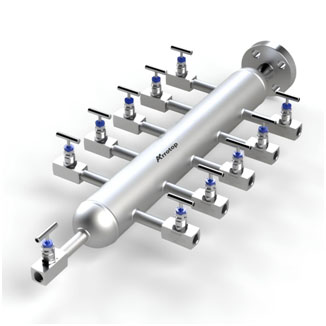
Used for distributing clean compressed air to process instrumentation systems.
Applications
- Refineries
- Chemical plants
- Power stations
2. Pneumatic Air Headers
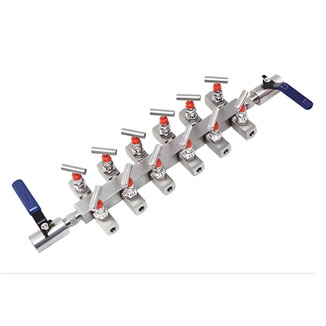
Designed for pneumatic actuator systems and automation equipment.
3. Gas Distribution Headers
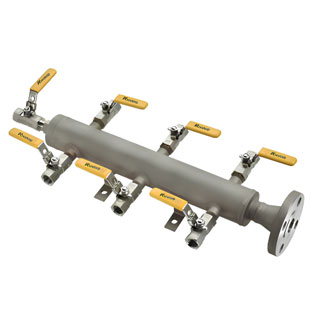
Used for distributing inert gases such as:
- Nitrogen
- Helium
- Argon
These headers are commonly used in laboratories and process industries.
4. Valve Mounted Air Headers
Integrated directly with pneumatic control systems for compact installations.
Air Header Materials
Material selection is critical for ensuring long-term durability, corrosion resistance, and pressure handling capability.
Common Air Header Materials
| Material | Key Features | Applications |
| Carbon Steel | Strong & economical | General industrial use |
| Stainless Steel 304 | Corrosion resistance | Food & pharma |
| Stainless Steel 316 | Better chemical resistance | Chemical processing |
| Brass | Good machinability | Low-pressure systems |
| Duplex Stainless Steel | High strength & chloride resistance | Offshore industries |
| Super Duplex Stainless Steel | Excellent corrosion protection | Marine environments |
| Monel | Seawater resistance | Offshore & marine |
| Inconel | High-temperature resistance | Extreme industrial environments |
| Hastelloy | Chemical resistance | Aggressive chemical plants |
For harsh industrial environments, advanced alloys such as Duplex, Monel, Inconel, and Hastelloy provide superior operational reliability.
Air Header Specifications
Selecting the right air header requires careful evaluation of technical specifications.
Important Air Header Specifications
| Parameter | Description |
| Operating Pressure | Maximum working pressure capacity |
| Design Pressure | Pressure rating for safe operation |
| Operating Temperature | Temperature range compatibility |
| Number of Outlets | Distribution capacity |
| Outlet Size | Connection dimensions |
| Inlet Size | Main supply connection |
| Material Grade | Corrosion & pressure resistance |
| Valve Type | Isolation functionality |
| Mounting Type | Installation configuration |
| End Connections | Threaded, flanged, welded |
Standard Pressure Ratings
Air headers are manufactured according to various pressure standards.
Common Pressure Ratings
- 150 PSI
- 300 PSI
- 600 PSI
- 1000 PSI
- Higher custom pressure ratings
- The selected pressure rating depends on system operating conditions.
Air Header End Connections
Different industrial systems require different connection styles.
Common End Connections
- NPT Threaded
- BSP Threaded
- Socket Weld
- Butt Weld
- Flanged Ends
Threaded air headers are commonly used for instrumentation systems, while welded or flanged designs are preferred for heavy-duty industrial applications.
Industrial Applications of Air Headers
Air headers are widely used across multiple industries due to their ability to simplify compressed air distribution systems.
1. Oil & Gas Industry
Air headers supply compressed air to:
- Pneumatic actuators
- Emergency shutdown systems
- Process control instruments
Corrosion-resistant materials such as Stainless Steel, Duplex, and Monel are preferred in offshore environments.
2. Chemical Processing Plants
Used for distributing clean instrument air in highly corrosive process areas.
3. Power Generation Plants
Air headers support:
- Turbine control systems
- Pneumatic valves
- Boiler instrumentation
4. Pharmaceutical Industry
Stainless steel air headers provide hygienic and contamination-free air distribution.
5. Food & Beverage Industry
Used in pneumatic automation systems where clean compressed air is essential.
6. Marine & Offshore Applications
Super Duplex and Monel air headers are ideal for:
- Seawater exposure
- High-humidity environments
- Corrosive offshore conditions
7. Water Treatment Plants
Air headers distribute compressed air to:
- Pneumatic valves
- Filtration systems
- Instrumentation panels
Advantages of Using Air Headers
Air headers provide several operational and maintenance advantages.
Key Benefits
Simplified Piping Layout
Reduces the need for multiple individual air supply lines.
Improved Maintenance
Isolation valves allow maintenance without shutting down the entire system.
Enhanced Safety
Centralized distribution improves system monitoring and leak detection.
Space Saving Design
Compact arrangement minimizes installation space.
Better System Organization
Improves pneumatic line management.
Cost Efficiency
Reduces installation and maintenance costs.
Operational Reliability
Ensures stable and consistent air distribution.
Design Considerations for Air Headers
Proper air header design is essential for safe and efficient operation.
Important Design Factors
1. Pressure Requirements
The header must safely handle operating and surge pressure conditions.
2. Flow Capacity
The manifold diameter and outlet sizing must support required airflow.
3. Corrosion Resistance
Material selection should match the process environment.
4. Outlet Quantity
Adequate outlets should be planned for future expansion.
5. Drainage System
Moisture removal systems are critical for instrument protection.
6. Installation Environment
Outdoor installations may require weather-resistant coatings or exotic alloys.
Common Problems in Air Header Systems
Improperly designed or maintained air headers may face operational issues.
Common Challenges
- Internal corrosion
- Moisture accumulation
- Leakage at threaded joints
- Pressure drop
- Valve failure
- Contamination buildup
Regular inspection and proper material selection significantly improve service life.
Maintenance Tips for Air Headers
Routine maintenance ensures reliable operation and extended lifespan.
Best Maintenance Practices
- Inspect valves regularly
- Drain condensate periodically
- Check for leaks
- Verify pressure ratings
- Clean internal passages
- Replace damaged fittings
- Inspect corrosion-prone areas
Preventive maintenance helps avoid costly downtime and pneumatic system failures.
Industry Trends in Air Header Manufacturing
Industrial air distribution systems are evolving with modern automation and safety requirements.
Emerging Trends
- Compact modular designs
- High-pressure air headers
- Corrosion-resistant exotic alloys
- Automated monitoring systems
- Customized manifold solutions
- Precision-machined outlet configurations
Industries increasingly demand customized air headers tailored to specific process conditions and installation requirements.
Why Industries Choose Arrotop Air Headers
At Arrotop, air headers are engineered for performance, reliability, and long-term industrial durability.
Key Features
- Precision-engineered construction
- Corrosion-resistant materials
- Custom outlet configurations
- High-pressure compatibility
- Availability in SS316, Duplex, Monel & Inconel
- Reliable pneumatic distribution
- Industrial-grade quality standards
Arrotop solutions are designed to meet the evolving needs of industrial automation, instrumentation, and compressed air systems.
Conclusion
Air headers are essential components in modern industrial pneumatic and instrumentation systems. By efficiently distributing compressed air from a single source to multiple outlets, they simplify piping layouts, improve maintenance accessibility, and enhance operational reliability.
From oil & gas and power generation to pharmaceuticals and offshore industries, air headers support critical process control applications where consistent compressed air supply is essential. Selecting the right material, pressure rating, outlet configuration, and valve arrangement plays a major role in ensuring safe and long-lasting performance.
With advanced material options such as Stainless Steel, Duplex, Monel, Inconel, and Hastelloy, modern air headers are capable of operating in highly corrosive and demanding industrial environments. For industries seeking dependable air distribution solutions engineered for durability and precision, Arrotop provides high-quality air header systems tailored to modern industrial requirements.