
Industrial flow control systems require reliable valves that can efficiently regulate, isolate, and control the movement of liquids, gases, and steam. Among the various industrial valves available today, butterfly valves are widely preferred due to their compact design, cost-effectiveness, and fast operation.
Butterfly valves are commonly used in industries such as oil & gas, chemical processing, water treatment, HVAC, pharmaceuticals, food processing, and power generation.
At Arrotop, industrial butterfly valves are engineered to provide dependable performance, durability, and efficient flow control for a wide range of industrial applications.
What is a Butterfly Valve?
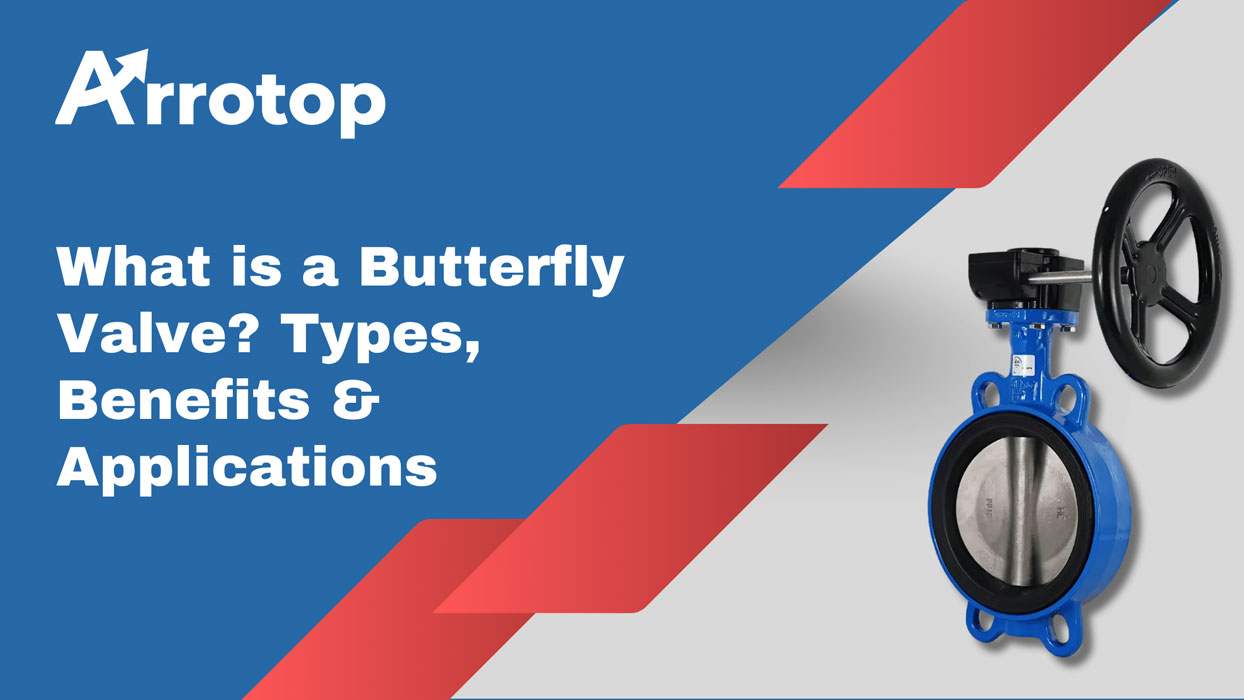
A butterfly valve is a quarter-turn rotational motion valve used to start, stop, or regulate the flow of fluids in a pipeline. The valve operates using a circular disc mounted on a rotating shaft.
When the valve handle or actuator rotates the disc:
- The valve opens to allow fluid flow.
- The valve closes to stop the flow completely.
Because of their simple design and quick operation, butterfly valves are widely used in industrial piping systems where efficient flow control is required.
Working Principle of a Butterfly Valve
The working principle of a butterfly valve is simple and effective.
The valve contains:
- A valve body
- Circular disc
- Stem or shaft
- Seat
- Handle or actuator
Open Position
When the disc rotates parallel to the flow direction, fluid passes through the pipeline with minimal restriction.
Closed Position
When the disc rotates perpendicular to the flow, it blocks the passage and stops the flow completely.
Butterfly valves require only a 90-degree rotation to fully open or close, making them faster than many conventional valve types.
Types of Butterfly Valves
Different industrial applications require different butterfly valve configurations depending on pressure, temperature, and operating conditions.
1. Wafer Type Butterfly Valve
Wafer butterfly valves are compact valves installed between two pipe flanges.
Applications:
- Water treatment plants
- HVAC systems
- Utility pipelines
Advantages:
- Lightweight design
- Cost-effective
- Easy installation
2. Lug Type Butterfly Valve
Lug butterfly valves contain threaded inserts that allow independent bolting on both flange sides.
Applications:
- Chemical industries
- Industrial process systems
- Dead-end service pipelines
Advantages:
- Strong mechanical support
- Easy maintenance
- Suitable for isolation service
3. Double Offset Butterfly Valve
Also known as high-performance butterfly valves, these valves use two offsets in the disc arrangement to reduce friction and improve sealing performance.
Applications:
- Oil & gas industries
- Steam systems
- High-pressure applications
Advantages:
- Reduced seat wear
- Improved durability
- Better sealing performance
4. Triple Offset Butterfly Valve
Triple offset butterfly valves are designed for critical high-temperature and high-pressure applications.
Applications:
- Power plants
- Petrochemical industries
- Refinery systems
Advantages:
- Zero leakage performance
- Metal-to-metal sealing
- Long service life
Benefits of Butterfly Valves
Butterfly valves are widely preferred because of their operational and economic advantages.
Compact Design
Butterfly valves occupy less installation space compared to gate or globe valves.
Lightweight Construction
Their lightweight structure simplifies handling and installation.
Quick Operation
Quarter-turn operation allows fast opening and closing.
Cost-Effective Solution
Butterfly valves are generally more economical, especially for larger pipe sizes.
Low Maintenance
Simple construction with fewer moving parts reduces maintenance requirements.
Excellent Flow Control
They provide efficient throttling and flow regulation capabilities.
Automation Compatibility
Butterfly valves can easily integrate with pneumatic, electric, or hydraulic actuators.
Industrial Applications of Butterfly Valves
Butterfly valves are used in various industrial sectors for flow isolation and control.
Oil & Gas Industry
Used in:
- Pipeline systems
- Refineries
- Gas distribution networks
Water Treatment Plants
Ideal for:
- Water distribution
- Wastewater treatment
- Filtration systems
Chemical Processing
Suitable for:
- Corrosive chemicals
- Process fluid handling
- Industrial mixing systems
HVAC Systems
Widely used in:
- Chilled water systems
- Cooling towers
- Ventilation pipelines
Power Generation Plants
Used for:
- Cooling water circulation
- Steam applications
- Utility services
Food & Pharmaceutical Industries
Preferred because of:
- Hygienic design
- Easy cleaning
- Reliable sealing performance
How to Select the Right Butterfly Valve
Choosing the correct butterfly valve depends on several operational factors.
Consider:
- Fluid type
- Pressure rating
- Temperature conditions
- Pipe size
- Material compatibility
- Sealing requirements
- Automation needs
Proper valve selection helps improve:
- System efficiency
- Equipment safety
- Operational reliability
- Maintenance performance
Why Choose Arrotop Butterfly Valves?
Arrotop Butterfly Valves are manufactured to meet demanding industrial requirements with a focus on quality, durability, and precision engineering.
Key Features:
- Robust construction
- Corrosion-resistant materials
- Reliable sealing performance
- Smooth flow control
- Long operational life
- Suitable for multiple industrial applications
Arrotop delivers dependable industrial flow control solutions designed for efficient and long-term operation.
Conclusion
Butterfly valves are one of the most efficient and widely used industrial valves for controlling the flow of liquids, gases, and steam. Their compact design, quick operation, low maintenance, and cost-effectiveness make them suitable for a wide range of industrial applications.
From water treatment plants and HVAC systems to oil & gas and chemical industries, butterfly valves continue to play a vital role in modern industrial flow control systems.
For high-quality butterfly valves and industrial flow control solutions, explore the advanced product range offered by Arrotop.